
Introduction
Da Vinci Xi robotic surgery is an advanced form of minimally invasive surgery that helps surgeons perform complex procedures with enhanced visualization, precision, and control.
The da Vinci Xi system combines high-definition 3D visualization with flexible, wristed instruments that offer greater dexterity and control than conventional surgical instruments. For women undergoing gynecological procedures, these capabilities can be particularly useful when surgery involves delicate tissues, complex anatomy, or difficult-to-reach areas.
Recognizing the growing role of advanced surgical technology in women’s healthcare, Eva Women’s Hospital is bringing the da Vinci Xi Robotic Surgical System to Ahmedabad, Gujarat. For patients, this advancement can open the door to a minimally invasive surgical approach where robotic assistance may support greater precision, controlled movements, and detailed visualization.
But how exactly does da Vinci Xi achieve this level of precision, and what could it mean for women undergoing gynecological surgery? Let’s understand how the technology works and where it can make a difference.
What Is the da Vinci Xi Robotic Surgical System?
The da Vinci Xi is a surgeon-controlled robotic-assisted surgical system designed to support minimally invasive procedures with enhanced visualization, dexterity, and control. It is not an autonomous robot and does not make surgical decisions on its own. Instead, the surgeon operates the system from a console, guiding every movement of the instruments.
So, what makes this technology different from conventional minimally invasive surgery?
The answer lies in how the system combines advanced visualization with highly controlled instrument movements.
How Does da Vinci Xi Work?
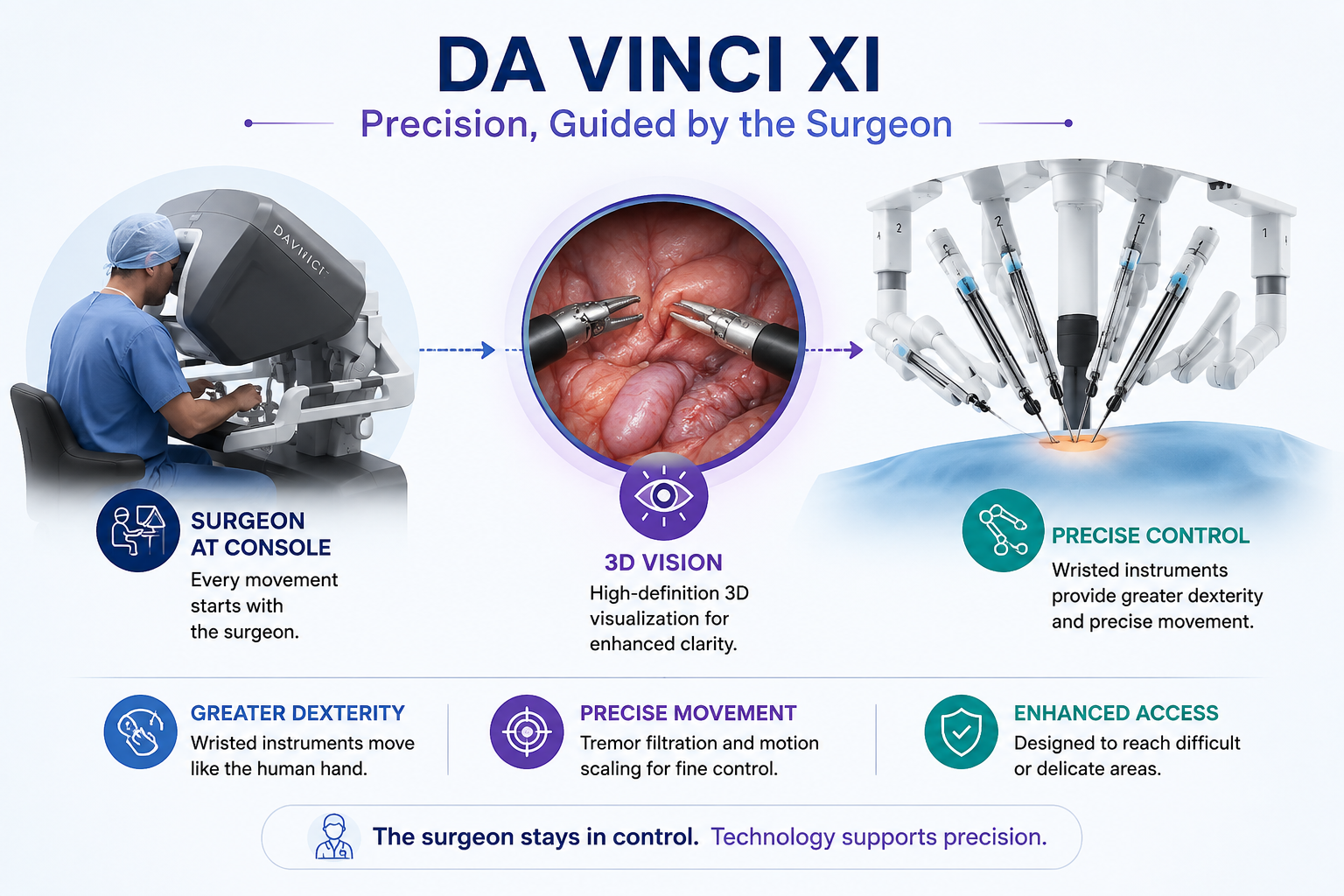
During da Vinci robotic surgery, the surgeon sits at a console and views the operating area through a high-definition 3D system. The robotic arms hold small, articulated instruments that can rotate and move with a greater range of motion than conventional straight laparoscopic instruments.
The system also translates the surgeon’s hand movements into precise instrument movements while filtering natural hand tremors. This gives the surgeon greater control while working in delicate or confined surgical areas.
In simple terms, the surgeon remains in complete control, while the technology provides enhanced vision, dexterity, and precision to support the procedure.
How Does da Vinci Xi Improve Surgical Precision?
The precision of da Vinci robotic surgery comes from combining enhanced visualization, highly flexible instruments, and surgeon-controlled movements. Together, these capabilities can help surgeons work with greater control during appropriate minimally invasive procedures.
Enhanced 3D Visualization
The da Vinci Xi provides highly magnified, high-definition 3D visualization that can help surgeons see anatomy with greater clarity and depth perception. This enhanced view can make it easier to identify anatomical structures, distinguish tissue planes, and maintain orientation during intricate procedures.
Greater Instrument Dexterity and Control
The da Vinci Xi uses wristed instruments that can bend and rotate beyond the range of conventional laparoscopic instruments, giving surgeons greater dexterity during minimally invasive surgery. These instruments are controlled directly by the surgeon and are designed to translate hand movements into precise instrument movements.
Precise Movement in Complex Surgical Areas
The combination of 3D vision, instrument dexterity, and surgeon-controlled movement can support precise surgical handling in complex or difficult-to-reach areas. This can be particularly relevant when a procedure involves delicate tissues or requires careful dissection and suturing.
Importantly, robotic technology does not operate independently. The surgeon remains responsible for planning and performing the procedure, while the system provides tools designed to enhance visualization, access, and control.
Why Does Surgical Precision Matter in Women’s Healthcare?
In gynecological surgery, precision matters because surgeons often work around delicate tissues, blood vessels, nerves, and closely positioned pelvic organs. The importance becomes clearer in minimally invasive procedures, where surgeons work through small access points rather than a large surgical incision.
Conventional laparoscopy already offers the benefits of a minimally invasive approach, but robotic-assisted systems can add 3D visualization, wristed instrument movement, and tremor filtration to the surgeon’s capabilities.
When clinically appropriate, robotic assistance can support minimally invasive surgery through small incisions while giving the surgeon enhanced control and visualization. However, robotic surgery is not automatically the best choice for every woman. The appropriate surgical approach depends on the condition being treated, complexity of the procedure, individual patient factors, and the surgeon’s expertise.
What Is Robotic Gynecological Surgery Used For?
Robotic gynecological surgery may be used in procedures such as hysterectomy, myomectomy for uterine fibroids, surgery for endometriosis, and certain complex gynecological procedures. In some settings, robotic techniques may also be used for selected gynecologic oncology procedures, depending on the condition, surgical plan, and surgeon’s expertise.
For example, during a hysterectomy, robotic assistance may provide the surgeon with enhanced visualization and instrument control while removing the uterus through a minimally invasive approach. Similarly, in procedures involving fibroids or endometriosis, the additional dexterity and visualization may be useful when working around delicate pelvic structures.
The goal is to select the surgical approach that offers the most appropriate balance of safety, effectiveness, and patient benefit for an individual case.
Is Robotic Surgery Suitable for Every Patient?
No. Robotic surgery is not automatically suitable for every patient or every gynecological procedure. The decision depends on the medical condition, complexity of the surgery, patient history, available technology, and the surgeon’s training and experience.
A thorough evaluation helps determine whether robotic-assisted, laparoscopic, vaginal, open, or another approach is most appropriate for the individual patient.
Robotic Surgery vs Conventional Laparoscopic Surgery: What’s the Difference?
Both conventional laparoscopic surgery and da Vinci robotic surgery are minimally invasive approaches that allow surgeons to operate through small incisions. The key difference is how the surgeon interacts with the instruments and views the surgical field.
| Feature | Conventional Laparoscopic Surgery | da Vinci Robotic Surgery |
| Visualization | Laparoscopic camera view | High-definition 3D visualization |
| Instrument movement | Uses relatively straight, rigid instruments | Uses articulated, wristed instruments |
| Surgeon control | Surgeon directly manipulates laparoscopic instruments | Surgeon controls robotic instruments from a console |
| Instrument dexterity | Limited by the movement of straight instruments | Greater range of motion and wrist-like movement |
| Surgical approach | Minimally invasive | Minimally invasive |
The distinction is therefore not between “traditional” and “advanced” surgery, but between different ways of performing minimally invasive surgery. Robotic systems can provide additional visualization, dexterity, and motion control that may be useful for selected procedures.
What Does Robotic Surgery in Ahmedabad Mean for Patients?
For women looking for advanced surgical care closer to home, the arrival of robotic-assisted technology in Ahmedabad represents an important development in minimally invasive gynecological care. Robotic surgery in Ahmedabad can give patients access to a surgical approach that combines the expertise of a trained surgeon with advanced visualization, dexterity, and instrument control.
Eva Women’s Hospital & Endoscopy Center has an established focus on advanced gynecological and minimally invasive surgery. With the upcoming introduction of the da Vinci Xi Robotic Surgical System, Eva is bringing another level of surgical technology to its gynecological care in Ahmedabad.
For patients, this means having access to a technology designed to support surgeons during selected procedures where enhanced visualization, precise movement, and minimally invasive techniques may be beneficial. The decision to use robotic assistance will still depend on the individual patient, the procedure, and the treating surgeon’s clinical assessment.
Conclusion
The evolution of da Vinci Xi robotic surgery represents an important step forward in minimally invasive surgical care. For women undergoing appropriate gynecological procedures, these capabilities may offer valuable support when careful surgical handling is required.
With the da Vinci Xi Robotic Surgical System coming soon to Eva Women’s Hospital & Endoscopy Center, women in Ahmedabad will have access to another advanced surgical technology as part of their gynecological care options. If you are considering surgery, speak with your gynecological surgeon to understand whether robotic-assisted surgery is appropriate for your condition and treatment plan.
FAQs
What is da Vinci Xi robotic surgery?
Da Vinci Xi robotic surgery is a surgeon-controlled, minimally invasive surgical approach that uses 3D visualization and articulated instruments to support precise movements during selected surgical procedures. The surgeon remains in complete control throughout the procedure.
Is da Vinci robotic surgery safe?
Da Vinci robotic surgery is generally considered safe when performed for appropriate patients by trained surgical teams. As with any surgery, potential risks depend on the procedure, the patient’s health, and individual circumstances.
What are the benefits of robotic gynecological surgery?
Robotic gynecological surgery may offer enhanced 3D visualization, greater instrument dexterity, and precise surgeon-controlled movements. These capabilities can be particularly useful during selected complex or delicate minimally invasive procedures.
Is robotic surgery available in Ahmedabad?
Robotic surgery is becoming increasingly accessible in Ahmedabad. Eva Women’s Hospital & Endoscopy Center is bringing the da Vinci Xi Robotic Surgical System soon, expanding the city’s advanced minimally invasive gynecological care options.